June 29, 2026 · News
WMF Bologna 2026: Niva's physics-native approach to safety underscored in robotics and manufacturing
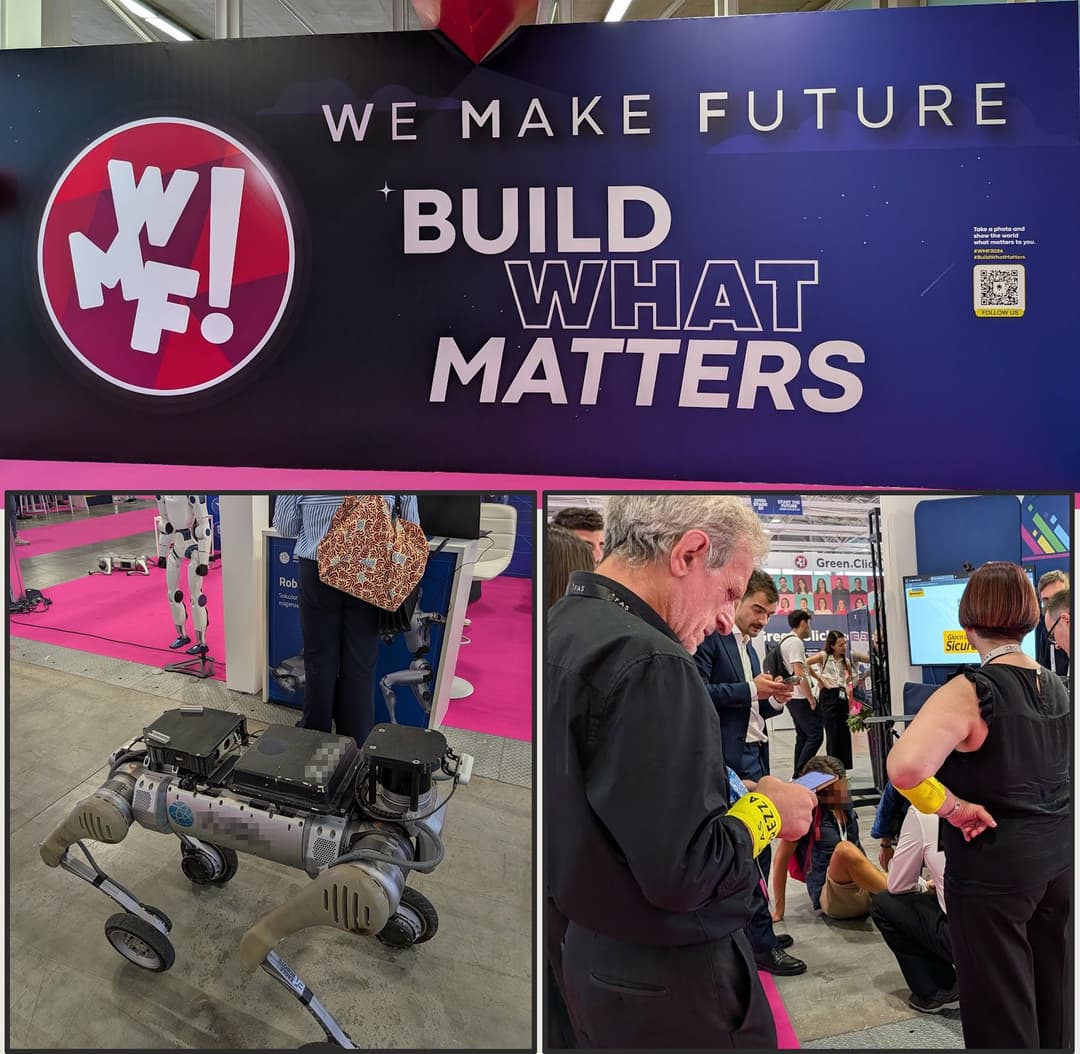
Caption: Top: WMF 2026's official conference theme on venue signage. Bottom: Unitree B2-W on show floor (left); WMF event safety personnel attending to the injured person (right).
Niva attended We Make Future 2026 in Bologna, Italy (24-26 June 2026) at BolognaFiere, the largest tech, AI, and innovation event in Europe, with more than 73,000 attendees from over 90 countries, supported by the European Commission. The event positions itself around AI and the future of work, with a focus on manufacturing and robotics - demonstrating 'Physical AI' platforms across the show floor.
What follows is an account of what Niva observed at WMF, why it matters for those deploying autonomous machines, and how the Manifold platform is designed to address the architectural problem that we observed at WMF.
An uncontrolled robot, people injured
On the afternoon of Wednesday, 24 June 2026, Niva was engaged with personnel from an Italian robotics integrator and distributor for Unitree. The unit on display, a Unitree B2-W: roughly 60-65 kg (132-143 lbs) of base hardware, capable of 6 m/s, with a sensor stack on top that included LiDAR and RGB depth cameras. The robot was running a simple programmed circuit around the booth, with the operator's laptop showing a mission planner logging numerous "Avoiding Obstacle" events as conference-goers walked past.
The Niva team was mid-conversation with the integrator's team about Manifold and the architectural difference between reactive obstacle avoidance and physics-grounded world understanding. Before the explanation could be completed, the robot deviated from its programmed waypoints, accelerated forward and left at significant speed, and ran into several pedestrians. One man was knocked down and required attention from event safety personnel. The robot was not stopped by its operators. It came to a halt on its own. The integrator's team retrieved it, brought it back to the booth, and powered it down.
An unfortunate incident, especially for those injured, but a single observed failure at a single event. By itself, it could be dismissed as an anomaly, an unfortunate edge case, the kind of thing that happens occasionally when robots meet the real world.
The more profound observation is... it is not an anomaly. It is the predictable consequence of an architectural pattern that the Physical AI industry has normalized, and it was visible in Bologna at WMF 2026.
The pattern around the failure
The integrator whose robot lost control is not building bespoke hardware. They are selling and integrating commercial-grade robots from Unitree, a major Chinese manufacturer, with their own software stack and sensor configuration layered on top. The base platform is marketed for inspection, security, emergency response, and industrial automation. The integrator's value-add is mission planning, sensor integration, and customer relationship. The underlying control architecture, the part that decides what the robot does moment to moment, is built-in.
A few booths over, another European vendor was demonstrating their own Physical AI offering: a humanoid, a smaller quadruped, a quadcopter, and a tracked ground robot, all marketed as integrated physical automation. Their architecture, as described by their team, used two networked mini-PCs running a local language model. The smallest robot communicated with the local model over Wi-Fi for all reasoning. The larger quadruped ran a reduced-size language model onboard and escalated to the local model when it encountered situations it could not resolve.
In other words: when the robot is confused, it asks the larger language model for help, over a wireless link, in the middle of a crowded trade show floor. Though that scenario could easily be a crowded factory floor, an RF-inundated cityscape, or a robot monitoring critical infrastructure.
Niva was curious about their approach, especially as the vendor mentioned the use of quadcopters. The answer was revealing, and concerning. At first, "critical supplies" between hospitals were mentioned. After a few follow-up questions, the team said they were working with hospitals on AI-controlled drone transport of human organs for transplant.
Across the WMF show floor, robots cruised pink-carpeted aisles past pedestrians who had no expectation that the systems were operating without verifiable safety controls. Humanoid robots walked between booths. Delivery bots wove through foot traffic. The marketing language was consistent: physical AI for critical operations, physical automation in the real world. What the conference-goers did not understand is that the architectures underpinning those systems were not capable of providing physical AI with any meaningful control or safety.
The limits of transformer and trained architectures
The robot that lost control at WMF was not failing because its sensors were broken or there was inadequate compute. It failed because reactive obstacle avoidance is a fundamentally limited approach to operating around humans and in highly changeable environments. The system was doing what it was designed to do: detect an obstacle, generate a path around it, detect the next obstacle, generate the next path. What it could not do is reason about what was actually happening in its environment, predict the consequence of its commanded motion, or guarantee that the commanded motion would not produce a collision.
The vendor with the language-model-controlled drones was operating under a different but related limitation. Large Language Models (LLMs) and Vision-Language-Action (VLA) models are correlation engines. They produce outputs that are statistically plausible given their training data. They cannot reason about or predict physics, they cannot guarantee what they will or will not do, and they degrade in predictable ways when conditions move outside their training distribution. Adding guardrails on top of a language model does not make it deterministic, because the underlying system remains probabilistic by design. Even loaded with explicit written rules, the attention mechanism dynamics of transformer-based models cause adherence to those rules to degrade over time (and in some cases, a short amount of time). This is well-documented in published research on long-context language model behavior. It is not a flaw that better engineering can eliminate; it is a property of the architecture.
In early 2026, Niva performed head-to-head testing for demonstration purposes against a publicly released model from a leading VLA company. In that benchmarking scenario, Niva used a Universal Robots UR5e arm, along with identical sensors and action objectives. Within seconds of connecting the VLA model, the arm swung wildly at speed that nearly injured a Niva employee, prevented only by the UR robot arm emergency stop button. Consequently, Niva wrote a safety suite around the VLA model in a single day, in order to test it without endangering the team. The leading VLA company in question listed safety as a 'future research initiative' on their website at the time. The episode is not unusual. It is what happens when control software is shipped without architectural safety primitives, and customers are left to invent their own or simply risk injury and damage.
What architectural limits and risk look like with higher stakes
The WMF incident was relatively small in scale. Several people were affected by the uncontrolled robot, one man was visibly hurt; the injury appears to have been limited. The story could have been worse. The architectural pattern that produced it however, does not stop at quadrupeds on trade show floors.
Consider what the same architectural limitations imply when applied to AI-controlled drone transport of human organs between hospitals during a European summer.
A heart removed from a donor enters a cold ischemia window of roughly 4-6 hours before the tissue becomes non-viable. A lung is similar. A liver affords 8-12 hours. Once that organ is in transit, there is no fallback. The recipient is on the table or in pre-op. A second matched donor is not waiting in standby. If the drone fails, the organ dies, the recipient may die, and the chain of decisions that brought a donor family, a surgical team, and a regional transplant network to that moment unwinds in ways that are disastrous.
Bologna, the week of the fair, saw unseasonably high temperatures of 37-39°C (99-102°F). Major hospitals are typically located in city centers, as is the case with Bologna, surrounded by taller buildings, in dense urban cores that generate substantial heat island effects. The physics that an AI-controlled organ transport drone would need to understand, in real time, would include:
▪ Density altitude shifting by more than a thousand meters from standard conditions, reducing lift envelope by 15-25 percent
▪ Battery thermal degradation under load and ambient stress, eroding state-of-charge margins as internal battery pack temperatures rise
▪ Thermal updrafts from sunbaked roofs and pavement producing localized columns of vertical air movement
▪ Wake turbulence in the flight canyons downwind of urban buildings, persisting for 5-10 building heights past the obstacle
▪ RF degradation through urban canyons, where multipath, diffraction, and building-induced path loss reduce wireless link quality and connectivity drones rely on (particularly if dependent on remote reasoning systems)
▪ Standard aerial challenges; precipitation, bird strikes, power lines, and other airspace users along the route
On paper, each of these challenges is survivable. In the real world, they compound. A drone with reactive control or LLM-in-the-loop reasoning cannot anticipate the compound stress regime, because it was never trained in it, nor is it architecturally capable of calculating it. No responsible operator has flown organs through urban canyons at 38°C with that architecture either: this is uncharted territory. Testing aside, the first time the system encounters the regime in a critical context is the time when it cannot fail.
Physics-native control does not have this problem, because the equations that govern flight, thermal behavior, and battery electrochemistry do not change. The temperatures, densities, and electrochemical parameters change; the structure of the computation does not. The physics can be, and must be, verified before and during flight - that is the fundamental requirement for critical operations.
What architectural safety actually requires
The pattern at WMF, across multiple vendors, is the same: probabilistic perception and reasoning systems are treated as if they can make physical safety guarantees, with no deterministic substrate underneath to enforce what the probabilistic layer cannot.
Safety guarantees in physical systems are not a property of better policies, better training data, or larger context windows. They are a property of architecture. Specifically: Predictions about the physical world must come from explicit physics, not from learned approximations. The physical world is more complex and variable than a training program can ever approximate. Learned components can propose candidate actions; only physics-validated solutions should result in actions. Determinism cannot be a runtime check performed by a heuristic validator. It must be a property of the system by construction, such that invalid inputs are disallowed, and invalid outputs are not possible - not merely detectable. Reasoning about the world must be causal, grounded in the constitutive equations that govern materials and motion, rather than correlational, where patterns may or may not hold outside their training distribution.
These are not philosophical preferences or ideals. They are the engineering requirements for any system whose failure mode involves critical operations, including harm to people or property.
What commercial users should demand of industry
The visible failure at WMF was relatively small. The trajectory of the industry, as evidenced by what was on the show floor in Bologna, is not. Vendors are openly marketing AI-controlled systems for safety-critical applications, defense and security, industrial manufacturing, infrastructure monitoring, healthcare and surgery - even medical logistics. While all good use cases, the underlying architectures being employed cannot make the fundamental guarantees that those applications require. Event organizers permit systems to operate around the public. Buyers procure them without demanding architectural evidence of safety. Investors fund them on growth metrics that do not include meaningful and detailed failure-mode analysis.
Industry must do better, and the engineering to do so, already exists. A robot operating around people should not be permitted to commit an action without physics validation. A drone carrying a human organ should not be permitted to depart without verified physics for every regime it will encounter en route, and the ability to adjust based on regime changes during flight. A system marketed as 'Physical AI' should be required to demonstrate that its physics is verified, that its determinism is architectural rather than aspirational, and that its safety guarantees are properties of construction rather than properties of marketing copy.
The man on the floor in Bologna was lucky. He went home with minor injuries and an interesting story. The next person, encountering the next failure, may not.
Manifold was designed to address many fundamental issues affecting AI today: deterministic, physics-native, runtime focused, edge compute capable, incredibly fast (60 Hz, under 20 ms end-to-end), hyper-accurate (physics calculations verified to the limits of 64-bit computation), and generalizable across materials and scenarios. Manifold is not a VLA or digital twin, it is a runtime physics engine for any system that interacts with the physical world. Critically, Manifold can augment other systems (LLM, VLA, industrial ML, classical automation, offline sim) with the physics understanding and certainty they were never designed to have. There is a better way, and Niva has developed it.
What's next for Niva?
Niva will be attending the 40th Annual Small Satellite Conference (SmallSat) in Salt Lake City, Utah (23-26 August 2026). The conference is the premier gathering for the global small satellite community, with roughly 5,000 attendees expected and a 40-year history of bringing together the commercial, government, and academic builders of small spacecraft. The 2026 edition focuses on the technologies driving constellation success across commercial, defense, and scientific missions.
Commercial traction continues to move forward. Since Niva's first conference in March, Manifold has progressed with lower latency, sharper accuracy verification against published references, additional physics domains, and tighter integration with existing stacks. The positioning continues to sharpen around the same core claim: runtime physics-native AI that augments the systems customers already run, without rip-and-replace, without retraining - maintaining incredible speed, hyper-accuracy, and deterministic physics certainty. Niva is excited to see what comes next as we continue to chart the future.